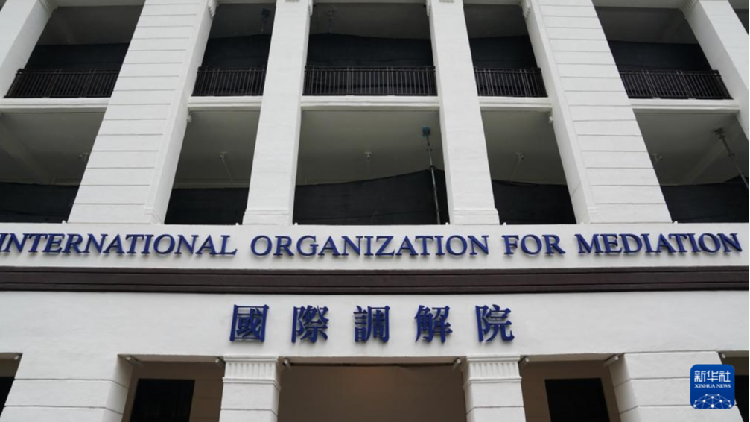
<img src='https://news.cgtn.com/news/2025-05-30/Why-China-helped-set-up-International-Organization-for-Mediation-1DNEMicySJi/img/06c0fde52c9b41c895c0f01ea959ec72/06c0fde52c9b41c895c0f01ea959ec72.png' alt='The building of the International Organization for Mediation, south China's Hong Kong SAR, May 30, 2025. /Xinhua'
China’s Hong Kong Special Administrative Region (HKSAR) on Friday witnessed a signing ceremony of the Convention on the Establishment of the International Organization for Mediation (IOMed).
In his speech at the ceremony, Chinese Foreign Minister Wang Yi hailed the establishment of IOMed as an “innovative step in international rule of law” with “great significance in the history of international relations.”
Experts said this milestone is more than a ceremonial launch of a new international institution, terming it a significant step in global governance that fills a crucial gap in international dispute resolution.
They said it also reflects China’s philosophy of “harmony,” promoting dialogue and win-win solutions while moving away from zero-sum thinking. It offers a fairer, more accessible alternative to Western-dominated dispute mechanisms, opening new avenues for all nations, particularly developing countries, to resolve conflicts peacefully and equitably.
Representatives from 32 countries signed the convention, officially becoming founding member states of IOMed. High-level representatives from over 50 countries and nearly 20 international organizations attended the ceremony.
Practicing purposes and principles of UN Charter
The IOMed was founded to mediate disputes between states, or between a state and foreign investors, and international commercial disputes based on the will of relevant parties. Notably, it is the first organization of its kind to facilitate international disputes through mediation, filling an institutional gap in international mediation.
Article 33 of the UN Charter clearly states mediation as one of the first means that should be tried in seeking peaceful solutions to international disputes. However, there didn’t exist an intergovernmental legal organization in this field. By establishing IOMed, China has helped filled this gap, providing an essential public good in the realm of global governance and the rule of law.
Xu Ying, a Beijing-based international affairs expert, said that the creation of IOMed also represents a necessary evolution in global dispute resolution.
According to Xu, existing dispute settlement bodies, like the World Trade Organization, were shaped by the interests of a few dominant powers. Today, these mechanisms struggle under the weight of global realities and often disadvantage developing nations. IOMed, therefore, serves as a complementary institution, offering a fairer and more credible alternative for dispute resolution.
Promoting peaceful resolution of disputes
Resolving conflicts through dialogue and mediating disputes through consultation is a common value and aspiration of all major civilizations in the world. Wang said that the birth of the IOMed can help transcend the “you-lose-I-win” zero-sum mentality, promote the amicable resolution of international disputes and foster more harmonious international relations.
Harmony-based conflict resolution principles are long embedded in Eastern traditions. In China, there is a well-known saying, “Harmony is precious,” which aligns with the concept of mediation as emphasizing mutual respect, compromise and the pursuit of win-win outcomes as the foundation for peacefully resolving disputes.
In addition to its peaceful nature, IOMed offers a more flexible, cost-effective and efficient approach to dispute resolution for all parties, especially for developing countries. It will complement existing international dispute mechanisms like litigation and arbitration.
“The IOMed addresses one of the key criticisms of current mechanisms: that they are often inaccessible, expensive and tilted in favor of wealthier nations. This new court is explicitly designed to be different. Its procedures are accessible. Its emphasis on neutrality and non-coerciveness ensures fairness,” said Xu.
Bridging East and West via Hong Kong
The IOMed will be headquartered in HKSAR. Wang said that Hong Kong’s handover is itself a success story of peaceful settlement of international disputes.
He also listed the advantages of Hong Kong, saying the city enjoys exceptional advantages in international mediation. He noted, for instance, its affinity to the motherland and connection to the world, its enabling business environment, its highly developed legal system, and its strength in both common law and civil law.
Recently, three international rating agencies – S&P, Moody’s and Fitch – affirmed Hong Kong’s “stable” rating outlook. Beyond its long-standing role as a global hub for finance and commerce, the city also boasts a strong common law tradition and a world-class legal services ecosystem, including a mature judiciary, multilingual professionals and extensive experience in cross-border mediation. It also has deep ties with both East and West, which further solidifies its position as an ideal location for IOMed.