
Jazz Piano
Transcription is an important part of any piano player’s toolkit. It allows you to capture the musical concepts that a master musician has developed and their harmonic “tricks,” so that they can be learned by another. The process of transcribing is also one of the best ways to understand what makes a particular song or solo so memorable.
For beginners, a transcription of a jazz standard is an opportunity to learn the piano notation of a piece that they have heard many times before. This can help them learn how to play the melody and chords of a song, so that they can eventually create their own piano arrangements. It can also be useful for intermediate players who are working on their improvisation skills.
Using a transcription can also be an effective way to practice transposition and modulation. Generally, when a composition is written in a major key, changing the key signature will change the whole piece to another major key. Changing the key by an interval such as a perfect fifth higher or lower will keep the piece in the same tonality, but at a pitch that is more comfortable for the pianist to play.
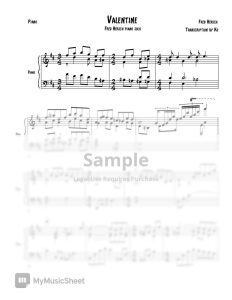
Jazz Piano Transcription
The first step in learning to transcribe is to become familiar with the keyboard notation. This can be done by practicing reading the music in a different key on your instrument and then looking up the corresponding scale degrees in the chromatic circle. This will give you the number of steps necessary to get from the original key to the desired key. Once you have this number, it will be much easier to transpose the music at sight and will sound more accurate.
Another aspect of the transcription process is to use the articulations that are most appropriate for each section of the piece. For example, if a piece has large florid arpeggiations, you may want to break them up into multiple parts and dovetail them together to give the impression of continuous movement.
For this reason, it is a good idea to use the transposition tool in your piano software or website to check how the articulations will sound in each key. If you are unsure, it is often helpful to ask an experienced musician or use the original source recording to hear how a professional performer would play the piece.
Another part of the transcription process is to note the timbral differences between the instruments used in the original recording and the piano. Using the piano to mimic the timbres of other instruments can be an effective way to bring out the emotional context of a piece. For example, if you are performing an arrangement of a Fats Waller song, it might be helpful to add some oboe and flute parts to imply the “leggiero” effect.
Finally, a pianist can use the transposition tool to experiment with chord shells and guide tone voicings. These types of voicings can be more expressive and have a different tone than root position chords. This technique can be difficult for beginners, but can be very rewarding once mastered.